Plumbing
Plumbing
Primary/Secondary

How Does Radiant Cooling Work?
A radiant cooling system is a temperature-controlled surface that cools indoor temperatures by removing sensible heat and where more than half of heat transfer occurs through thermal radiation. Heat will flow from objects, occupants, equipment and lights in a space to a cooled surface as long as their temperatures are warmer than that of the cooled surface and they are within the line of sight of the cooled surface. The process of radiant exchange has a negligible effect on air temperature, but through the process of convection, the air temperature will be lowered when air comes in contact with the cooled surface.
Radiant cooling cools a floor or ceiling by absorbing the heat radiated from the rest of the room. When the floor is cooled, it is often referred to as radiant floor cooling; cooling the ceiling is usually done in homes with radiant panels. Although potentially suitable for arid climates, radiant cooling is problematic for homes in more humid climates.
Most radiant cooling applications have been based on aluminum panels suspended from the ceiling, through which chilled water is circulated. To be effective, the panels must be maintained at a temperature very near the dew point within the house, and the house must be kept dehumidified. In humid climates, simply opening a door could allow enough humidity into the home to allow condensation to occur.
The panels cover most of the ceiling. In all but the most arid locations, an auxiliary air-conditioning system will be required to keep the space’s humidity low.
Structures built on concrete slabs are prime candidates for radiant cooling systems, and radiant ceiling/floor cooling takes advantage of the same principle using chilled water.
Radiant cooling systems offer lower energy consumption than conventional cooling systems based on research conducted by the Lawrence Berkeley National Laboratory. Radiant cooling energy savings depend on the climate, savings are in the range of 30% compared to conventional systems.
These savings can be primarily attributed to:
1) Less energy required to transport heat transfer medium (water) when compared to conventional HVAC where air is used. The graphic below shows the same.
2) Chilled water supply from the chiller is typically at 16 deg C compared to 7 deg C for conventional HVAC. This also leads to additional savings.
Radiant Heating
Science shows that heat emission from the human body occurs mainly via three mechanisms: radiation, evaporation and convection. Humans feel most comfortable when they can regulate at least 50% of their heat emission via radiation, and when their feet are warmer than their heads.
Radiant heating systems provide heat on the basis of low heating surface temperatures over a large area and an even air temperature distribution with mild, comfortable radiated energy. In contrast to conventional forced-air systems, a radiative equillibrium is generated between people and the surfaces throughout the room, more closely achieving the optimal thermal comfort level for occupants.
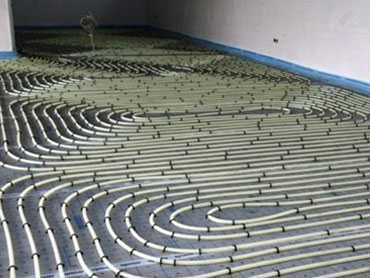
JSOMA ’s radiant heating systems work by circulating warm water through a network of pipes placed in the floor, wall or ceiling. Heat is gently radiated from the panel, warming the surfaces, objects and air in the room to create a comfortable environment.
The water for a radiant system can be warmed with boilers, geothermal heat pumps, solar collection systems and water heaters.
Our systems are compatible with hardwood, carpet, vinyl, ceramic, tile and natural stone floor coverings.
Advantage
Step onto a floor with JSOMA radiant heating and experience comfort at its best. Heat is gently radiated through the space virtually eliminating cold spots and temperature fluctuations. Radiant heating is quiet, clean and economical, and works with a variety of heat sources and floor coverings. Other benefits include:
Increases Comfort
Step onto a floor with JSOMA radiant heating and experience comfort at its best. Heat is gently radiated throughout the space, virtually eliminating cold spots and temperature fluctuations. A radiant heating system also keeps floors warm and dry.
Enhances Control
It’s easy to zone a radiant heating system using the JSOMA PRO-BALANCE manifold combined with multiple thermostats. This allows you to adjust temperatures in a single room or a group of rooms, based on activity and usage levels. For example, a guest room can be kept at a lower temperature when not in use.
Offers Flexibility
Radiant heating can be used in floors, walls and ceilings and can be installed in a single room or throughout your home or building. There are no heaters, radiators or additional vents, so you’ll have more design freedom and open space. Radiant heating is a great choice for today’s open floor plans, especially in areas with high ceilings.
Improves Energy Efficiency
Radiant heating allows a thermostat to be set as much as 4ºF (2ºC) lower than it would be with traditional hot air systems without sacrificing comfort. These lower operating temperatures coupled with the superior heat transfer properties of water can reduce fuel consumption, potentially saving up to 30% per year in heating expenses. And since radiant heating can be used with a variety of heat sources including geothermal heat pumps, solar collection systems and condensing boiler technologies, additional savings are possible.